
Industrial Automation
Controls, Drives and Virtual Lines, Engineered as One System
Automation projects rarely slip on paper. They slip on site, when separately engineered logic, drives and screens meet for the first time. Engineer them together, test them on a virtual line, and arrive on site with most of the surprises already removed.
 INDUSTRIAL ROBOTICS & AUTOMATION
Controls, drives and virtual production lines working together.
Factory automation and digital manufacturing are usually bought by different teams and planned at different times. One builds the control system; the other decides what the line should look like. Bringing them together is what makes it possible to test real control code against a simulated line, size motion before equipment is ordered and prove throughput before floor space is committed.
Factory Automation
Controllers, drives, operator panels, safety and CNC work best when they are engineered as one system rather than assembled from separate projects. A single engineering environment shares tags, diagnostics and configuration across all of them, so the machine behaves as one unit and is easier to support after handover.
 PLC / HMI / CONTROL INTEGRATION
-
Programmable controllers from compact machine control to high-performance and fail-safe systems
-
Operator panels and visualisation built from the same project as the control logic
-
Distributed I/O and industrial networking across machines and lines
-
Drives and servo motion, from single conveyors to coordinated multi-axis systems
-
CNC for machine tools, from standard turning and milling to multi-axis and multi-channel
-
One engineering framework for configuring, programming, simulating and diagnosing the whole system
-
Staged migration of ageing control systems without a single high-risk shutdown
Digital Manufacturing
A production line is one of the largest investments a manufacturer makes, and too many are still debugged after installation. Digital manufacturing builds the line, the robot cells and the operator stations in software first, so layout, cycle time and investment can be compared on numbers rather than opinion.
 DIGITAL FACTORY / VIRTUAL COMMISSIONING
-
Discrete-event plant and line simulation for throughput, buffers, bottlenecks and staffing
-
Robot cell validation for reach, cycle time and collision-free motion
-
Offline robot programming while the current line keeps producing
-
Ergonomic assessment of manual stations using human simulation
-
Process plans linked to the product's bill of materials
-
Layout and investment scenarios compared before capital is committed
Virtual Commissioning: Where the Two Meet
The strongest results come where the two areas overlap. Virtual commissioning connects the real controller program to a simulated line or machine, so logic, interlocks, sequences and fault handling are tested at a desk. By the time hardware arrives, the code has already run through its normal and fault sequences.
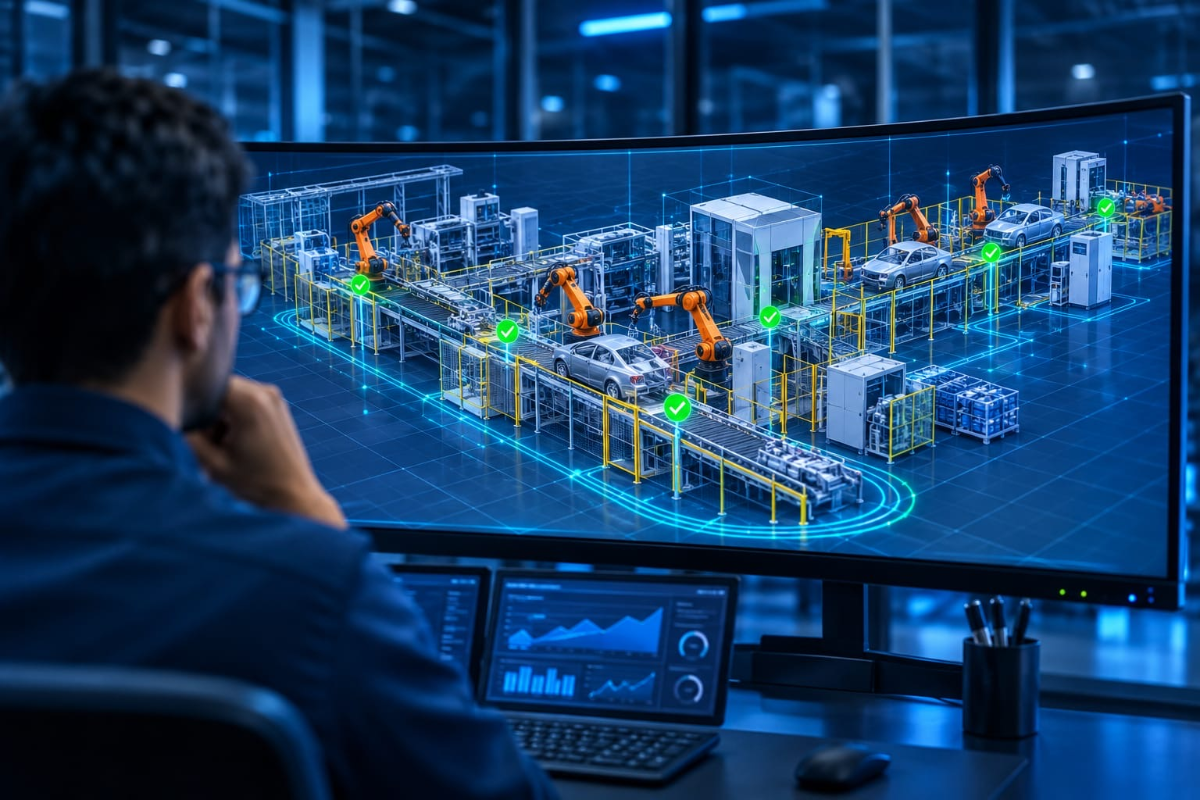 VIRTUAL COMMISSIONING & DIGITAL TWIN
Engineering
Real controller logic, interlocks and sequences
Virtual Testing
Simulated production line, machine and fault handling
On-Site Commissioning
Bring previously tested code to the installed system
How Much of Your Last Commissioning Could Have Happened at a Desk?
Share the layout, cycle-time target or control architecture of your next project. We'll map which parts of it can be engineered, simulated and tested before anything is installed.
Request a Demo